
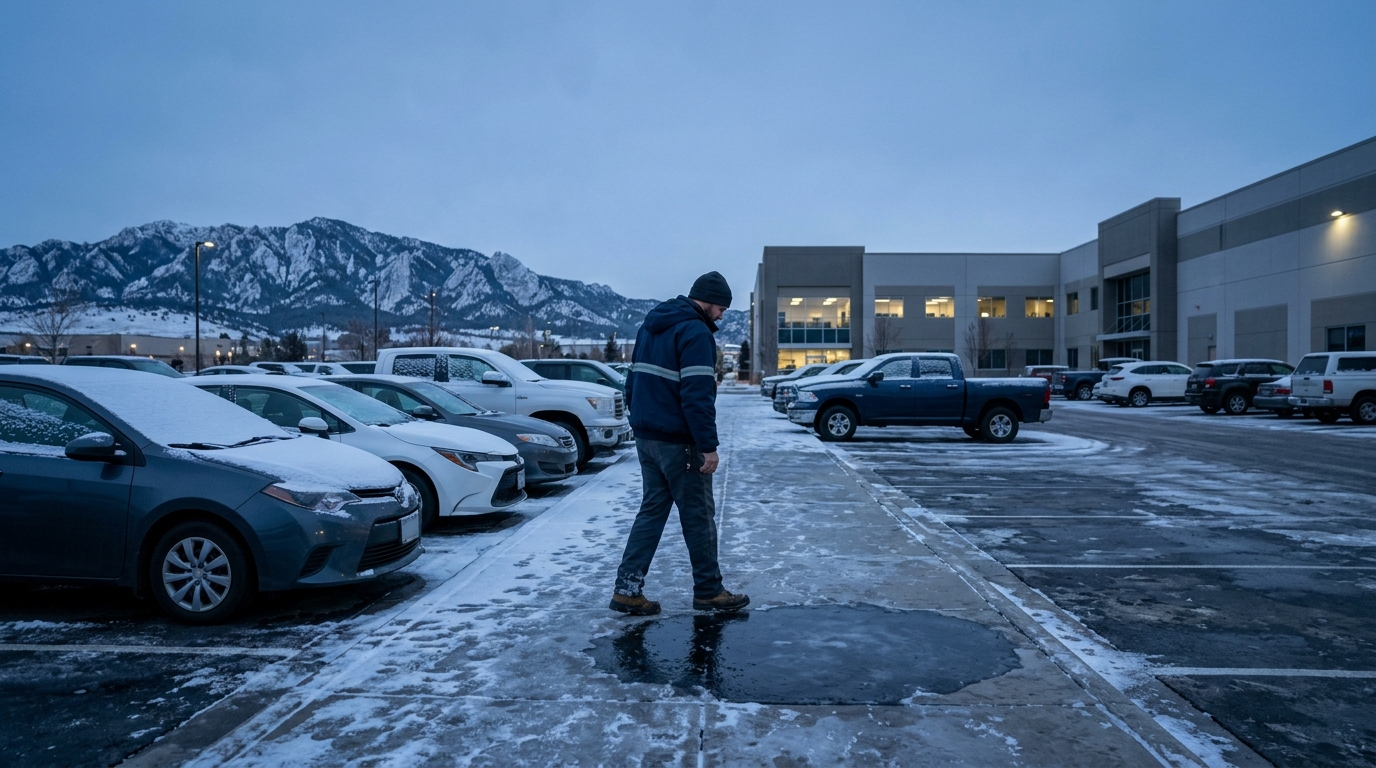
Does Colorado workers’ compensation cover a slip-and-fall injury in an employer parking lot during icy weather?
An injury from ice or snow in an employer parking lot, at an entrance, on a required walkway, or at a jobsite may qualify for Colorado workers’ compensation benefits. The answer is highly fact-specific, but frequently the answer is "yes." A central question is whether the injury arose out of and occurred in the course of employment, rather than simply whether the fall happened before or after a shift.
Winter conditions can create serious hazards for Colorado workers. If you were hurt in a slip-and-fall incident, I can review the circumstances, explain the workers’ compensation process, and help you assess the options available for a Colorado workplace injury claim.
The Basic Standard for a Colorado Work Injury Claim
Colorado workers’ compensation generally applies to injuries that arise out of and occur in the course of employment. These related requirements focus on the connection between the injury and the job.
“Arising out of” employment concerns whether the work or work environment contributed to the risk of injury. “In the course of” employment generally addresses the time, place, and circumstances of the incident. Neither phrase is resolved by a single fact, and every case deserves a careful review.
For example, an employee who slips on ice while performing an assigned task may have a different claim than an employee who falls in an area with no meaningful relationship to the employer or the job. As a workers’ compensation attorney serving Colorado, I evaluate the complete situation rather than relying on assumptions.
Why the Ordinary Commute Rule Is Not the Entire Answer
People often hear that injuries occurring during an ordinary commute are not covered by workers’ compensation. That general principle can be relevant, but it does not automatically decide every fall in a parking lot, on a walkway, or near an employer’s entrance.
The details matter. A parking area may be owned, leased, maintained, designated, or otherwise controlled by the employer. An employee may have been required to use a particular route to enter the building, collect equipment, report to a supervisor, or travel between work locations. A jobsite may also present different considerations than a public location visited solely during a personal commute.
Because the line between a commute and work-related access can be complex, I encourage injured workers not to abandon a potential claim merely because the injury happened outside the main work area or close to the beginning or end of a shift.
Factors That Can Matter in Snow and Ice Injury Cases
No two Colorado workers’ compensation claims are identical. In reviewing an injury involving snow or ice, the circumstances may include:
- Whether the employer owned, leased, maintained, or exercised control over the parking lot, entrance, walkway, or jobsite;
- Whether the employee was expected or required to use the area where the fall occurred;
- Whether the route was the usual or designated way to access the workplace;
- Whether the employee was on the clock, arriving for a shift, leaving after work, taking an authorized break, or performing a work duty;
- Whether the employee was carrying tools, wearing required gear, transporting materials, or otherwise completing job-related tasks; and
- Whether work conditions, scheduling requirements, or employer directions created a connection between the hazard and the employment.
These factors are not a checklist that guarantees coverage. They are examples of the evidence that may help show how an injury relates to employment. The Law Office of Ryan J. Hoover, LLC provides injured workers with direct, individualized legal guidance based on the facts of their cases.
Parking Lots, Entrances, and Required Walkways
A fall in a parking lot or at a building entrance can raise important questions about control and required access. If an employer directed employees to park in a specific area, maintained the lot, arranged snow removal, or required workers to use a particular entrance, those facts may be relevant.
Similarly, a walkway connecting a designated employee parking area to a workplace entrance may have a stronger work-related connection than an unrelated route chosen for personal convenience. The analysis can become more complicated in shared commercial properties, public parking areas, and buildings managed by a landlord. Even then, the employer’s expectations and the employee’s reason for being there may still matter.
I work to identify the practical facts that may not be obvious from an initial injury report, including who controlled the property, what access route employees were expected to use, and whether the incident occurred while the worker was engaged in an employment-related activity.
Jobsite Falls May Present Different Issues
Snow and ice hazards are not limited to office parking lots. Construction workers, delivery drivers, healthcare staff, maintenance professionals, and employees who travel between locations may encounter winter conditions as part of their regular duties.
When a worker slips on a jobsite while unloading equipment, inspecting an area, making a delivery, reporting to a remote location, or performing another assigned responsibility, the relationship to employment may be more direct. Still, the facts, medical evidence, reporting history, and insurer’s response can affect the claim.
My role as a Colorado workplace injury lawyer is to help clients understand how the facts may apply to their claims and to advocate for their interests when benefits are delayed, disputed, or denied.
Steps to Take After a Snow or Ice Injury
Prompt action can protect your health and preserve information that may be important later. After a workplace fall, consider taking the following steps as soon as reasonably possible:
- Report the injury promptly. Tell a supervisor or employer about the incident, the location, the conditions, and the injuries you experienced. Written reporting can help document the event.
- Seek authorized medical care. Employers and insurers may have procedures for selecting medical providers in workers’ compensation cases. Obtain needed care and follow the reporting process, while seeking emergency treatment when necessary.
- Photograph the conditions if it is safe to do so. Images of ice, snow accumulation, lighting, warning signs, drainage issues, footwear, and the surrounding route can be useful. Do not place yourself at risk to take photographs.
- Identify witnesses. Obtain names and contact information for coworkers or others who saw the fall, observed the conditions, or know the access route employees were expected to use.
- Preserve relevant items and communications. Keep the footwear worn during the incident, copies of reports, text messages, emails, schedules, photographs, and medical records. Avoid altering or discarding evidence that could help establish what happened.
- Do not make assumptions about coverage. A fall near the start or end of the workday is not necessarily outside the workers’ compensation system. A careful evaluation is particularly important when the injury involves an employer parking area, required entry route, or jobsite.
When an Insurer Questions or Denies the Claim
Insurers may question whether an injury occurred in the course of employment, whether the location was controlled by the employer, or whether the medical condition is connected to the fall. A denial is not the same as a final answer about your rights. It may be important to review the stated reason for the decision, the available evidence, and applicable deadlines.
The Law Office of Ryan J. Hoover, LLC assists Colorado workers who need clear legal help after a workplace injury, including when an insurance carrier challenges a claim. I provide personal attention and straightforward communication so clients can make informed decisions about their next steps.
FAQ
Is a fall on ice in an employer parking lot always covered by workers’ compensation?
No. Coverage is not automatic. The location, employer control, required access, timing, work duties, and other facts may affect whether the injury arose out of and occurred in the course of employment.
What if I fell before I clocked in?
Being off the clock does not necessarily end the analysis. If the fall occurred in an employer-controlled area or while using a required route to access work, the facts may support further review. The specific circumstances are important.
Should I use my own doctor after a work-related fall?
Colorado workers’ compensation cases can involve rules about authorized medical providers. Report the injury promptly and ask about the employer’s designated provider process. If you need emergency care, seek immediate medical attention.
What evidence should I keep after slipping on snow or ice at work?
Keep photographs, witness details, reports, medical records, work schedules, communications, and the footwear worn at the time of the incident. These materials may help clarify the condition of the area and the connection to employment.
Can I get help if my Colorado workers’ compensation claim was denied?
Yes. A denied claim should be reviewed promptly because deadlines and procedural requirements may apply. I can assess the information available and discuss potential next steps for a Colorado workplace injury or denied claim.
This article provides general information only and is not legal advice. Reading it does not create an attorney-client relationship. Workers’ compensation outcomes depend on the facts and applicable law.
If you were injured on snow or ice at work, in an employer parking lot, on a required entrance route, or at a jobsite, contact The Law Office of Ryan J. Hoover, LLC at (303) 414-2895 for help with a Colorado workplace injury or denied workers’ compensation claim.